

A Musical Metroid Restrospective
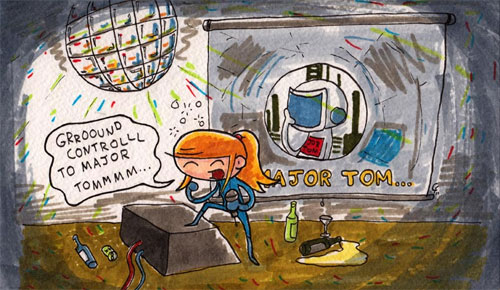
Image Credit: Chris Furniss. Click the image for more or to order prints.
“I had a concept that the music for Metroid should be created not as game music. . . . I wanted to create the sound without any distinctions between music and sound effects.”
This quote from a Gamasutra interview with Hip Tanaka (composer of the original Metroid) sums up the beginning of the atypical sound the Metroid series is now known for. While it has definitely evolved as the series progressed through the changes in composers and hardware, the spirit and tone of the original has mostly remained throughout.
Metroid (NES/FDS)
In a time when the industry was overwhelmed with upbeat, catchy melodies, Metroid stood against the grain. While the game is bookended with more driving themes such as Brinstar and the escape sequence, the majority of the soundtrack is made of far less traditional game music. The item room in particular consists of a combination of strange noises and awkwardly sparse high notes.
Kraid’s lair might stick out in our minds as a happy middle ground between catchy and moody, but it’s areas like Norfair, Ridley’s lair, and Tourian where Tanaka’s vision feels fully realized. The abstract structure of these themes make the planet Zebes feel truly alien.
Having come out on the Famicom Disk System first, the original score of Metroid (which never left Japan) had some subtle differences. There are a handful of themes that utilize the system’s wavetable channel. While purists might argue, the NES version we received in North America still fits the game like a glove and is a perfectly manageable version of the score.
Metroid II: Return of Samus (Game Boy)
With the exception of a few songs, Return of Samus managed to take Metroid music to an even more abstract place. In fact, most of Ryohji Yoshitomi’s score is hard to label as music, consisting purely of sound effects. Occasionally, a Tanaka-like melody will pop in and what’s there is certainly fitting. But aside from the tunnel theme, many would agree it has less staying power than the original game.
Super Metroid (SNES)
Much like the game itself, the soundtrack of Super Metroid could easily be considered the apex of the entire series. Kenji Yamamoto and Minako Hamano put together a phenomenal score that, while more melodically driven than its predecessors, retained an atmospheric, dark tone.
Each theme is memorable, but unintrusive. The music of the underwater area of Maridia is hauntingly beautiful. Areas like Crateria and Norfair even introduced choral elements that despite being synthesized still sound incredibly eerie.
A lot of attention is paid to dynamics. The slight variations in volume, especially when quickly rising and falling, only add to the unsettling nature of the tone. In stark contrast, some of the battle themes discard subtly with a very full, alarming sound that works as a great counter piece to the rest of the soundtrack. In all aspects, Super Metroid is a tough game to top.
Metroid Fusion (GBA)
For the simultaneous release of Metroid Fusion and Metroid Prime, the Super Metroid composers were split up leaving Yamamoto to score Prime with assistance from Kouichi Kyuma while Hamano and Akira Fujiwara handled Fusion.
The Fusion soundtrack certainly set the right mood, but was never able to reach the high bar set by Super Metroid. It’s not without its notable qualities, though. The modulating synths and punchy kick drums in themes like the Nightmare battle at least give it a different flavor.
Metroid Prime Trilogy (Gamecube/Wii)
With less hardware limitations, Kenji Yamamoto was able to play with a larger variety of sounds for the Metroid Prime soundtrack. He used more choral elements than Super Metroid as heard in the Hall of the Elders, but occasionally combined it with bits of electronica. Themes such as the Chozo Ruins took a very minimalist approach while battle themes like the Parasite Queen didn’t hold back.
I never quite felt anything as magical as Hamano’s Maridia, but the underwater frigate came close. Phendrana Drifts and the artifact temple further added to the more serene side of the score.
The second game followed fairly closely in style to the first. Of course, there are a few outliers such as the Dark Samus battle which sneaks in a little guitar here and there over a more traditional beat. But when it comes to personal favorites, Torvus Bog is the star of the show.
For the final game, Yamamoto was once again joined by Hamano, reforming the Super Metroid duo while adding Masaru Tajima to the mix. Despite the extra music staff, Prime 3 didn’t really rise above anything laid down in the first two games. It wasn’t worse either, but considering what they managed to do on the Super Nintendo, I expected a little more. Then again, I can’t deny the more dramatic sound of the title screen music.
Metroid Zero Mission (GBA)
Even before Metroid Prime 3, Yamamato and Hamano combined forces to tackle the Metroid: Zero Mission soundtrack. As a reimagining of the original Metroid, the soundtrack contained a lot of the same songs, yet the style sounded much different. If you were to take the melodies from the first game, add the choral style of the Prime series, and sprinkle a little bit of Super Metroid on top, you would have Zero Mission. This hodgepodge of styles is especially apparent in the Norfair arrangement.
Metroid Prime Hunters (DS)
Metroid Prime Hunters is an interesting case. Scored by Lawrence Schwedler and James Phillipsen, it often has a decidedly un-Metroid feel to it. There are still some ambient tracks that fit the mood, but a lot of it features beats that would feel more at home in popular electronica music. In fact, the Magma and Arctic Spawn battle almost feels like it could be on The Prodigy’s Fat of the Land. It’s not a bad soundtrack, but certainly a very different one.
Metroid: Other M (Wii)
I hate to end on a downer, but with Metroid: Other M being the last game I don’t have much of a choice. It was scored by Kuniaki Haishima who to my knowledge had never composed for a videogame before. I have not heard his anime or film scores, but his work on Other M is completely forgettable. Most of it is ambient noise while the rest of it is generic fluff with no real substance. It’s at its best when it steals a theme from another game, and even that it doesn’t do often.
The best song actually comes from the game’s live action trailer, but that’s just cheating.
———————————————
It’s hard to say what the future of Metroid holds, especially with the last game being such a departure from the norm. I’d love to see what Kenji Yamamoto could do with an actual choir (instead of a synthesized one). But I’m not opposed to some new blood either. That is, of course, as long as they do a better job than Haishima.

Tags: metroid, Metroid 25th Anniversary, Metroid Fusion, Metroid II: Return of Samus, Metroid Prime, Metroid Prime Trilogy, Metroid Zero Mission, Metroid: Other M, Retrospective, super metroid
This entry was posted on Wednesday, August 10th, 2011 at 5:00 am and is filed under Features, Music. You can follow any responses to this entry through the RSS 2.0 feed. You can leave a response, or trackback from your own site.








August 10th, 2011 at 1:53 pm
Jonah "spambot" Gregory says:I always forget the sparseness of the music in the old games because the ambiance is just that good.
August 11th, 2011 at 5:01 am
What Metroid Did Right - WingDamage.com says:[...] Staff « A Musical Metroid Restrospective [...]
August 11th, 2011 at 10:34 am
PStart says:One thing I never liked about Zero Mission was how it cut out the ‘happy’ second portion of the Escape Theme. The Zero Mission version does sound a lot more menacing overall, so I could only guess they did it because it would have sounded awkward to try and transition back and forth with the new style.