

Can Smartphones and Dedicated Portable Game Systems Coexist?
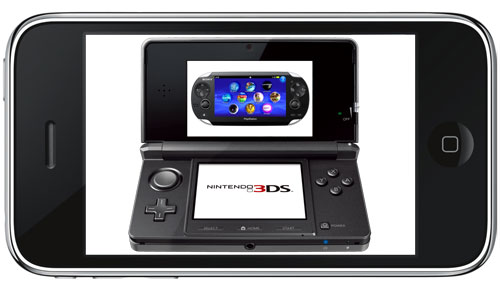
Much like the increase in digital distribution over physical media, the injection of smartphones into the portable gaming ecosystem has quickly caused many to declare dedicated portable game systems officially dead. But is that really so?
I believe that each platform has its strengths and weaknesses. They can… no, they SHOULD coexist. To get rid of dedicated portable game systems in favor of touch screen phones would be to force an unnecessary limitation on ourselves.
More Than Just Making Calls
Smartphones have provided us with a wealth of interesting game types at a fraction of the cost of retail games. Anywhere from $10 to as low as 99 cents can buy you a game that you might spend countless hours with. And with very little barrier to entry, many indie developers have managed to get more exposure than ever before.
Similar to the DS, the touch screen common on smartphones has allowed developers to explore unique control schemes and innovative new game types. While there’s certainly a lot of dregs to wade through (something true of all platforms), there are undoubtedly some quality games to find for those who take the time to look.
You’ve Got the Touch
While there are alternate control methods (such as tilt controls), devices like the iPhone primarily use the touch screen. When games are designed with touch control in mind, it can be a wonderful experience. Unfortunately, things don’t always work out that way.
Many games make use of a “virtual joystick” controlled by sliding your thumb around the screen. Generally, this only works for games that don’t require any kind of precision.
I recently played the iPhone version of NBA Jam. The virtual stick works adequately, but I became frustrated when I accidentally moved my thumb a bit too far and my character came to an abrupt stop. It’s sloppy, but it was one of the better experiences I came across.
The iPhone version of Mega Man 2 on the other hand is almost unplayable. I consider it to be one of the easiest classic Mega Man games and I’ve beaten it a ridiculous number of times, but on the iPhone I was in trouble. For action platformers, a virtual joystick just isn’t up to the task.
Fighting games don’t fare much better. While I was impressed that a version of Street Fighter IV works at all on a phone, it felt like nothing more than a short lived novelty in comparison to the real version. The amount of buttons had to be drastically reduced cutting the game’s depth considerably and the virtual joystick input is downright laughable for any kind of serious play.
You could argue that the iPhone version is a fraction of the cost of the upcoming 3DS version. But to be brutally honest, I would rather pay more for the game that actually works.
“But You Don’t Need Those Games To Be Portable!”
Inevitably, this is where the same argument comes up. I’m told that there are so many games in genres that do work well on smartphones that I shouldn’t care about the genres that don’t. These genres work better on consoles anyway, so I should only play them there.
Would you also tell me I shouldn’t listen to drum ‘n bass on my earbud headphones because my home stereo could do it better? Would you tell me that there are so many good soft rock songs that I shouldn’t care about listening to drum ‘n bass when I’m away from home? I hope not, because I would probably have to smack you.
The point is that sometimes I am in the mood for specific game types. No amount of other genres will scratch that proverbial itch.
Not Just For Short Bursts
Another remark I often hear is that if a portable game does provide a console-level experience full of deeper, more engrossing gameplay, than it has failed as a portable game. The logic here is that portable gaming is only good in short bursts.
Certainly, being able to quit anytime is important. But the DS goes into sleep mode when closed and the PSP sleeps when you flick the power switch. These are functions that are standard with every game, regardless of genre and it’s reasonable to assume the next iterations will do the same.
But are short bursts, such as while waiting in line while grabbing a bite to eat, the only time people play games? According to EA’s Vice President of Mobile Worldwide studios, Travis Boatman, users play mobile games at home 47% of the time.
Why would somebody play a portable game at home when they could play a console (aside from the 7% spent on the toilet)? Speaking from my own personal experience, there are many reasons to play a portable gaming device (whether it be a phone or dedicated system) over a console.
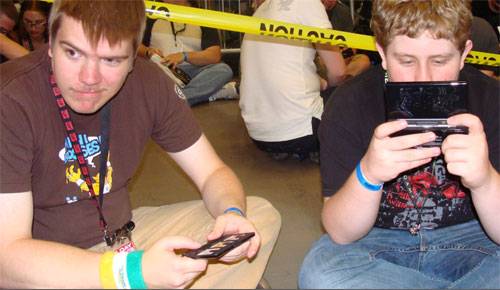
"The ridiculously long lines found at conventions are just one of the many situations where extended portable gaming sessions happen."
When multitasking for example. I recently reformatted my desktop computer and had to reinstall a large number of programs. My computer isn’t located near my consoles, so I got in a lot of quality “DS time” while occasionally pausing to swap discs or click OK on the next prompt.
My consoles are in a pretty secluded area of my room. Sometimes I want to be around where the rest of my housemates are, in the shared living room area, so that I can converse while relaxing and playing games. Moving my consoles to this area is out of the question.
I also know multiple people whose only means of gaming are portable devices. This can happen for various reasons, whether it be that portables games are often cheaper than console games or that the rest of their household uses the only available TV so much that consoles are not a practical option for them. Yet they still want to play new games, some of which require more than a touch screen or tilt controls in order to work well.
Never Overgeneralize
To say that there’s no place any more for dedicated portable game systems is to say that people like myself or my friends don’t exist. The fact of the matter is, people have a variety of different situations in life. You might not ever feel the urge to play a dedicated portable game system, but not everybody is in your situation or shares your taste in gaming.
It’s best not to use broad, sweeping statements to describe portable gaming habits. The reality of the situation if far more complex than that. I can’t speak for the distant future, but as of right now, there are plenty of reasons for people to game both on smartphones AND dedicated portable game systems, and I don’t see that changing any time soon.

Tags: 3DS, DS, iPhone, Mega Man 2, NBA Jam, Street Fighter IV, Super Street Fighter IV
This entry was posted on Monday, February 28th, 2011 at 5:00 am and is filed under Articles. You can follow any responses to this entry through the RSS 2.0 feed. You can leave a response, or trackback from your own site.







February 28th, 2011 at 11:46 am
Michelle says:I’m really old fashioned in the way that I am not a fan of mobile phone gaming. I realise that I am in the minority here, but I vastly prefer playing games on handhelds. It’s completely right for both markets to exist though, and I am definitely of the opinion that anything that encourages people to both start playing games or play more of them can only be a good thing.
I totally respect the mobile game market for that reason alone.