

Final Fantasy Mystic Quest Review: A Nostalgic Trip to a Simpler Time (SNES)

Over the years, Square Enix has managed to create some interesting spin-offs from it’s popular franchise Final Fantasy, such as Final Fantasy Tactics and Final Fantasy VII: Crisis Core. It actually goes all the way back to the Game Boy and SNES days. The Game Boy spin-offs were of the Final Fantasy Legend series, but what may be the most overlooked, under-appreciated, and simplified Final Fantasy iteration to date is Mystic Quest; a SNES title early in the console’s life.
If you haven’t played or heard of Final Fantasy Mystic Quest before, then I’m not surprised. It was an attempt by Squaresoft to release a Role-Playing Game for the “entry level” gamer and create a buzz among US players in the franchise and genre that had already gained great attraction in Japan. Mystic Quest was not a huge success, but it was one of the first steps in creating a mainstream audience for RPG games in the States.
FFMQ‘s story is about a boy named Benjamin who is chosen to save his World, which has been taken over by monsters. There are four different regions in the World, each of which harvests elemental energy from a crystal, giving the land resources and life. The invading monsters have stolen the crystals, causing their respective region to become lifeless. It is at this point Benjamin’s fate is decided by some mysterious old guy that magically travels on a cloud. He helps Benjamin escape a hometown destroying earthquake and gives him the quest of saving all four of the crystals and bringing peace to the World.
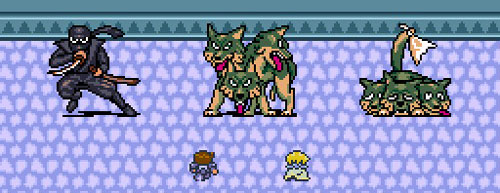
Sounds familiar right? Chosen hero. Four Crystals. Save The World. The basic premise of the original Final Fantasy just in a very simplified and casual form. The story never gets too serious or confusing to understand, and dialogue between characters is quite short and comical.
Squaresoft wanted to make a linear and accessible game for young and first time players of the series, and the end result was exactly that. The premise doesn’t stray too far from the tried and true RPG formula. Mystic Quest is presented in a typical top-down view throughout the entire game, when traveling and in battle. Unlike other Final Fantasy‘s, there is no exploring or roaming in between cities and dungeons on the World Map. You simply select which area you would like to enter by moving Benjamin to it’s location. No wandering, no forgetting which way you came, and most notably, no random enemy encounters.
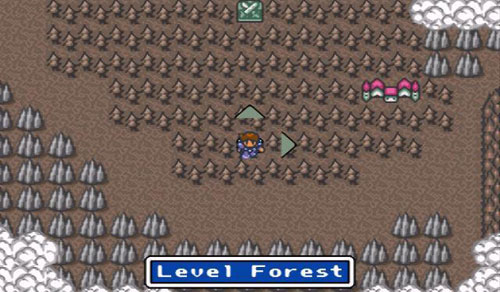
"The World Map"
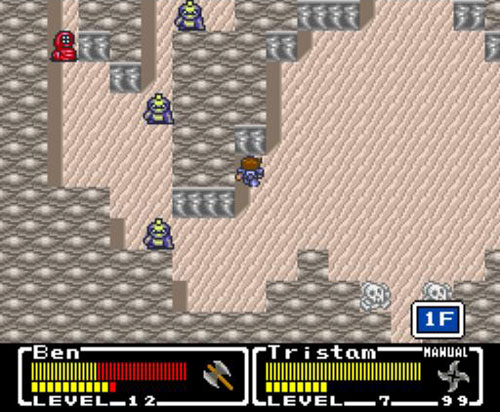
When progressing through dungeons and forests, enemies will show up on the screen and battle is initiated when the player comes in contact with one of them. This allows the player, in some cases, to move around enemies instead of fighting, but also allows players to level-grind to their heart’s content. On the World Map, between different locations you will find areas called “Battlefields”. Battlefields are optional areas that allow the player to initiate a battle, mainly to gain experience and gold as you travel to new locations. Each Battlefield allows you to initiate up to ten battles, and when all ten battles are cleared out the player is rewarded with either an item, extra experience, or gold. So in a sense, Battlefields replace Random Enemy Encounters on the World Map by giving the player the option to fight or not.
One thing veteran Final Fantasy players will notice, is that you cannot manually setup Benjamin or his companions with equipment. At the start of the game you are given a basic shield and armor. Along your adventure when you find new weapons and armor it automatically replaces the weaker item. For veteran RPG players, this may be considered a travesty, but for FFMQ, it’s linear approach to equipment characterization is seamless. The difficulty of the game relies heavily on how much you grind for levels, thus having stronger stats. This can make the experience a bit bland, but in return, you never have to worry about weather or not you have the right equipment to progress. While Benjamin can carry four different weapon types (sword, axe, claw and bombs), each with it’s own strengths and weaknesses, companion characters always have a set weapon.
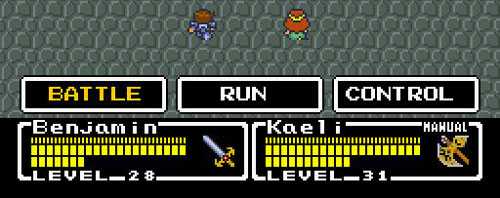
The battle system is exactly what you’d expect from a classic-style Final Fantasy game. Upon entering an encounter, you can decide to Battle or Run. Basic Battle commands are Attack, Spell, Item and Defense. You have the option of either controlling your companion or let the computer make their commands for them. Only three enemies at a time can be fought, making battles very fast. Spells are found rather than learned, and since there is no MP, each level of spells can only be used a certain number of times until they are replenished. Your basic attacks with weapons are usually enough to finish off most enemies, but I found spells to be the most effective when attacking multiple enemies at once, and of course for boss battles.
The failings of Mystic Quest are directly linked with the linearity intended to draw in new gamers. RPG’s are enriched with side-quests and extra locations for exploration. Here that is not the case, and it is somewhat mind-boggling as to why there is nothing outside of the main quest to do. The story is as straight-forward as they come. From the moment you start the game until you see the end credits, there are no breaks from the main storyline. It’s an unusual trait to find in a Final Fantasy game, or any RPG for that matter, and in Mystic Quest‘s case it could have really used a side-quest here or there to help hook the player.
The soundtrack easily shines as the best aspect of Mystic Quest. Chalk it up to pure nostalgia if you must, but once you put in 5-10 hours, the music lodges itself in your brain. Limited ROM capacity on SNES cartridges never seemed to present much of a problem for the composers of Squaresoft games, and Mystic Quest is thankfully no different. From the fast guitar riffs of the battle and boss themes, to melodic ballads you hear in villages, it’s memorable tunes still rank high on my list of game soundtracks.
In retrospect, you could say that Final Fantasy Mystic Quest was a game that could only appeal to a younger audience. With all it’s simplistic features, it’s hard for hardcore RPG’s fans to really dig into and keep interested. With it’s straightforward story, linear progression and non-traditional Final Fantasy aspects, it could definitely be a turn off to long-time series fans. I, on the other hand, found it to be one of the most memorable and coolest games on the SNES. Underneath it’s simplicity, there is a light-hearted gem to be found in this Squaresoft spin-off. Despite it’s shortcomings, the easily grasped gameplay and memorable soundtrack still create a fun and interesting experience. Nintendo Wii owners can experience this classic on the Virtual Console for 800 Wii Points. If you’ve never played it, I highly recommend giving it a try.

Tags: Final Fantasy, final fantasy mystic quest, FOG, Friday Old Games, JRPG, rpg, SNES, Square Enix, Squaresoft
This entry was posted on Friday, June 1st, 2012 at 5:00 am and is filed under Reviews. You can follow any responses to this entry through the RSS 2.0 feed. You can leave a response, or trackback from your own site.








June 1st, 2012 at 11:01 am
Jonah Gregory says:A friend and I rented this back in the day and nearly beat it over the course of the weekend. We had a lot of fun with it then. Now I’m curious to go back and see if it still holds any appeal for me.
June 1st, 2012 at 11:57 am
Sam Diaz says:I found it pretty fun replaying it again. Although it didn’t have that pure nostalgic feel mostly because I played it on the Wii and not the SNES, but it was a great to see how far the genre and franchise has come since 1992. This was the first Final Fantasy I ever played, so I may be a little biased in saying it still holds up. If you need a good reason to replay, do it for those awesome tunes