

Review: Gods Eater Burst (PSP)
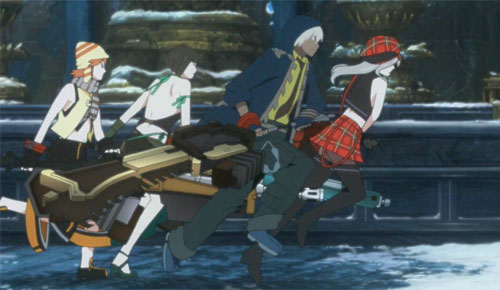
"Monster Hunter meets anime in Gods Eater Burst."
With the Monster Hunter franchise currently selling approximately one hojillion copies per entry in Japan, it’s no surprise that other companies are taking notice. Several games borrowing its formula of mission-based, cooperative beast slaying have popped up recently. Among them is Gods Eater Burst, a game that fortunately has enough fresh ideas to become more than just a “Monster Hunter clone”.
Gods Eater Burst takes place in a post apocalyptic future where giant monsters named Aragami attack what is left of civilization. As part of the anti-monster group Fenrir, you (as a male or female character of your own creation) must take these creatures down with your rag tag crew of overly fashion conscious teenagers.
More than just a setting, this sets up (for better or worse) Gods Eater‘s first obvious difference from Monster Hunter: the presence of a story. This is mostly told through cutscenes that occasionally appear between story missions. Sometimes they can be a bit long, but if you’re only in it for the action, they’re entirely skippable.
Veteran hunters will find the game’s skeletal structure quite familiar. There’s a mission counter you’ll grab quests from, you’ll teleport to an area and defeat the monster or monsters in question, you’re rewarded with money and materials to make new equipment with, and you’ll continue in this fashion until you unlock the next difficulty tier.
But while there’s the same co-op focus of four-man teams, Gods Eater adds a few tweaks to make solo play more interesting. Even when playing alone, you’ll fight alongside others in the form of NPCs. During story missions, these teams are chosen for you, but in free missions you’re able to select various party members from a list yourself. While on a mission, you can even make use of a set of squad commands to make your AI teammates a little more useful.
One of the most interesting features in Gods Eater is your weapon. Rather than choosing one weapon in a class, your weapon is composed of four separate parts, three of which have their own classes. In all, you’ll need a blade, gun, shield, and control unit. What’s really neat is that you can mix and match the sub classes any way you like. Want a giant, slow sword attached to a quick, weak shield? No problem! Now throw a bazooka, sniper, or assault gun on there while you’re at it.
Each weapon piece (aside from the control unit) has its own uniquely designed look, stats, and perks. Building a collection of parts to mix and match is very satisfying, which is good since this level of detail is sadly absent for the “armor” category. In fact, aside from two accessory slots, your clothing serves only aesthetic purposes despite the sometimes high crafting cost.
If you’re wondering why your weapon has both gun and blade parts, it’s because it transforms. At the touch of a button, you can switch between these two modes. This creates an interesting dynamic to the combat, since attacking in blade form fills the gauge your gun form uses as ammo. While you’re not required to make use of your gun form, it’s quite useful for targeting enemy weak points. It is also great for causing a variety of elemental damage.
Aside from normal attacking, you can do something that makes the game’s title make a little more sense. You can charge and release a giant mouth from your weapon to take a bite of an Aragami. This puts you in a powered up state and also grants you a double jump. More interestingly though, it has a Mega Man effect. Biting an Aragami will give you a few special bullets for your gun that are specific to that creature. Each creature has a few different ones that can be absorbed, but once they’re used up they’re gone until your next bite.
Speaking of bullets, one of the deepest aspects of Gods Eater is the bullet crafting system. Aside from a handful of default bullets, you can combine a large number of elements and behaviors into your own custom bullets. As you progress, you’ll gain more tools to work with. You could, for example, make a fire shot that, when enemy contact is made, causes a wave of ice to move around in a clockwise circle that’s axis has a 30 degree vertical angle. Confused yet? You can keep on stacking these behaviors to a ridiculous degree, but the more you add, the more energy it will take each time you fire it. There’s even a testing ground in the creation menu with in-depth stat readouts. It’s absurdly deep and fun to play around with, albeit confusing.
Combat in Gods Eater generally feels a bit faster paced than Monster Hunter. Between all the jumping and dashing (instead of dodge rolling), I definitely felt more agile. But the Aragami are quite agile themselves. Even some of the earlier boss monsters can move rather quickly and will keep you on your toes. The familiar mechanics of using traps and other items will definitely give you an easier time.
Map design is where the game really suffers. Being a post-apocalyptic world, you’ll often find yourself in destroyed urban environments. This would be fine if they weren’t all so flat and uninteresting. Monster Hunter has always nailed down the feeling of a living, breathing ecosystem. Gods Eater‘s maps, while similar in quantity, start to get repetitive far quicker. This is not only due to their bland structure, but also because of the creature density. The Aragami that aren’t boss monsters are still quite large and few in number. Without packs of small creatures, bugs, or resources to gather that are more than an occasional glowing mark placed at random, each stage feels barren. It fits the setting, but also makes each map fairly boring.
The monster design is quite bizarre. Each Aragami looks somewhere between a Final Fantasy summon and a Persona from SMT: Persona. Often times they have animal, human, and even mechanical elements to their design. Some even fire actual missiles at you. But while they certainly have visual cues to help you read their attacks, their behaviors and movements never felt quite as detailed as the creatures of Monster Hunter.
Still, Gods Eater manages to be a mostly successful alternative to Monster Hunter in spite its flaws. What it lacks in environmental immersion it makes up for in deep character customization and that oh so satisfying feeling of accomplishment from taking down a giant monster with your own skill. While it can get a bit repetitive and lacks the polish of its inspiration, Gods Eater Burst brings a lot of fresh new ideas to the old formula that make it worth checking out if hunting monsters is your thing.
This review is based on a copy of Gods Eater Burst provided to us by D3Publisher.

Tags: action, Bandai Namco, D3Publisher, God Eater, Gods Eater, Gods Eater Burst, Monster Hunter, psp
This entry was posted on Monday, April 11th, 2011 at 5:00 am and is filed under Reviews. You can follow any responses to this entry through the RSS 2.0 feed. You can leave a response, or trackback from your own site.









April 11th, 2011 at 9:31 am
Adam "Heat Man" Anania says:So something that occurred to me while reading, are all items and supplies gained from battles? Is there any instance of finding resources on the field, like how MonHun has bones and honey and all that? Also, are all battles mission oriented? Is it possible to just roam around a field freely and encounter beasts?
April 11th, 2011 at 10:15 am
Jesse "Main Finger" Gregory says:There are items on the field, but they’re far less integrated in the environment than Monster Hunter. As very briefly mentioned in the review, they’re glowing pieces on the ground that you can pick up. In a way, it kind of makes sense since you’re just salvaging random items from a broken down city, but it admittedly makes resource gathering less interesting.
As far as battles, yes they’re mission oriented. But you’re not always required to kill every monster. It didn’t seem to happen as often, but occasionally I’d still have an optional monster show up.
April 11th, 2011 at 11:35 am
linthuslyth says:Actually, I don’t think the glowing resource spots are random. They always seem to be on the same spot as far as I’ve noticed. Which, in my opinion, adds to the blandness of the environment. But hey, it is still just the second entry, I hope they refine it.
Hmm… I thought you would talk a little about the story and characters but I guess no one really cares about that. XD
April 11th, 2011 at 11:39 am
Jesse "Main Finger" Gregory says:I suppose it wasn’t very clear, but when I said random I actually meant in the sense that they have no relation to their surroundings. For example, in Monster Hunter if you wanted honey you would go to a beehive. In Gods Eater the items on the ground don’t seem to have any environmental reason for their location. That’s what I actually meant by saying random.