
Review: Machinarium (PC)
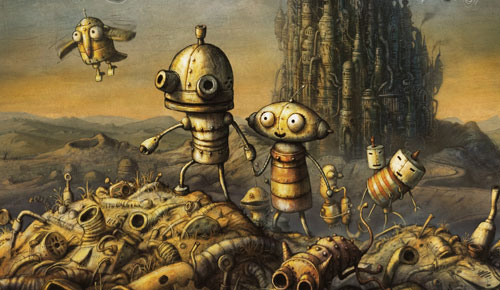
Games can grip you for many reasons; good stories and characters, interesting gameplay, or a fun setting to name just a few. With their independent title, Machinarium, Amanita Design has combined a point and click adventure game with traditional puzzles and an entertaining story of lost love and robots.
Machinarium uses a very unique visual style of very detailed hand-drawn, sprites and backgrounds. They have created an interesting world made of robots and mechanical devices that is bursting with personality.
I first saw Machinarium in action at PAX. At a quick glance, I didn’t know what I was looking at. I thought it was some kind of still screen or digital storybook page. I was intrigued when I finally saw the characters in motion. In some adventure games, the characters and backgrounds stand out from each other. They end up looking like they are from two different artists whose styles don’t mesh. This is definitely not the case here. It is obvious that a lot of time was put into the creation of all the game’s assets to make sure everything fit in.
Machinarium has no dialogue. The story is conveyed through character action and occasionally through talk bubbles that contain animated sequences. You play as a small robot who finds himself in a junkyard. He has been taken away from the house where he happily works alongside his girl robot counterpart. There is a gang of three ruffian-bots that have been causing trouble throughout the city, and it’s up to you to stop them and rescue your friend.
The basic gameplay is a point and click adventure. The twist is that you can only interact with objects within your reach. Fortunately, the robot’s mid-section can be stretched out to make him twice as tall, or scrunched down to get to hard to reach places.
In most instances, everything you need to solve the puzzle is either on the same screen or nearby. It’s really just a matter of using your wits to put the pieces together. There are also several traditional puzzles and brain teasers that must be solved to progress. One sequence even has you playing through parodies of some retro games like Space Invaders and Adventure to progress.
There is a built-in hint system in case you get stuck, which has two parts. The first part is a thought bubble at the top of the screen. Once per area, you can click on it to show you what needs to be accomplished to progress, but not how to accomplish it.
If you are still stuck, part two is a sealed book, which requires you to play through a very basic Shoot ‘em up (shmup) mini-game to unlock. If you make it to the end, it shows you step-by-step how to solve the room you are currently in. Take notes, because you have to play the mini-game each time you want to look at it.
Machinarium is a game I can highly recommend. The puzzles are fun and challenging, but have enough logic to keep you from banging your head on the keyboard in frustration. The world and the characters are very charming. The high level of detail in the game’s artwork really adds a lot to the experience. When I think of games that have stories and characters that will stick with me, Machinarium rises high on my list.

Tags: adventure, adventure games, Amanita Design, independent games, Machinarium, PC, Point and Click, Shmup, Space Invaders
This entry was posted on Monday, January 18th, 2010 at 5:00 am and is filed under Reviews. You can follow any responses to this entry through the RSS 2.0 feed. You can leave a response, or trackback from your own site.