

Review: Nano Assault (3DS)
“Too many ports!” consumers cried as they looked at the list of upcoming 3DS games after the system’s launch. With titles like Street Fighter, Ocarina of Time, and Star Fox taking most of the spotlight, it seemed the handheld’s early life would be devoid of truly new content.
But there sat Nano Assault, hiding away in the shadows during the busiest gaming season of the year, just waiting to be picked up by lovers of score based, arcade style action.
A sequel of sorts to the very finely crafted shmup Nanostray 2, Shin’en took the opportunity to mix things up by switching over to two similar genres. Much like the past game alternated between vertically and horizontally scrolling stages, Nano Assault divides its time between being both a twin stick shooter and a rail shooter.
Of course, considering the hardware, calling it a twin stick shooter is a bit misleading. With movement on the circle pad, aiming is handled by the face buttons (a/b/x/y). Using them in combination will only allow you to shoot in eight directions, a far cry from the wide range of motion provided by an actual stick. Clearly understanding this limitation, the game never throws as much at you as a high score run in Geometry Wars. The difficulty is always manageable allowing the buttons to be a surprisingly adequate stick substitute.
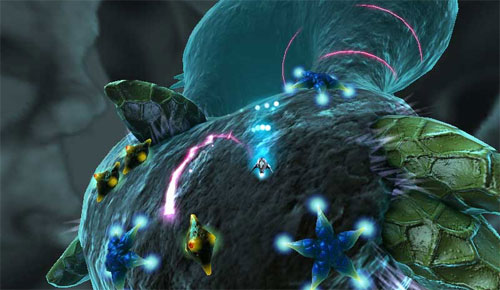
These ground stages have you roaming around the surface of round structures. But unlike Super Stardust HD, you won’t just be traveling around spheres. All manner of interesting shapes make up each stage. The goal is simple: to collect three DNA strands scattered across the map and eliminate all enemies. But the amount of variety present in each stage prevents it from ever getting stale.
Stages start short, but gradually increase in scope throughout the campaign. Environmental aspects like gates, rotating walls, and destructible sections allow levels to range from open shooting grounds to maze-like structures. The variance in enemy design also helps to keep things interesting as your pitted against tunneling worms, spinning saws, and organisms that explode into bullets to name a few.
Air stages make up the rail shooter segments. They’re far fewer in number, but are significantly longer than the ground stages. By default, there’s a weird disconnect between aiming and maneuvering. The targeting reticule actually starts moving before your ship will. This has its advantages since it allows you to aim at an enemy without moving directly in front of its line of fire, but I found it too disorienting. It wasn’t until I cranked the sensitivity to the maximum setting that I felt more at home, with the controls then resembling Star Fox.
Like the ground stages, the air stages have a lot of variety. Not just between each stage, but within different stage segments as well. You’ll dodge the environment almost as much as you’ll dodge enemy fire.
Most boss encounters take place with the rail shooter controls, but a handful make use of the twin stick mode and even a third mode. This third mode uses the twin stick controls while granting only left and right movement around a disk as you fire at an enemy in the center. Bosses are a real highlight as each feels different from the last. Unfortunately, the final boss is both one of the least interesting and least challenging fights in the game, making for a rather anti-climactic ending.
As you progress through the campaign, you’ll get a few different secondary weapons to play around with. You’ll only be able to select one per level, though, and certain weapons only apply to ground stages. It’s not much, but it allows you to mix up your play style a bit and they help fill the void caused by a lack of in-stage powerups.
Since the concept behind Nano Assault is that you’re fighting viruses in a microscopic ship, the art direction is very abstract. Expect lots of bizarre color palettes and blobular baddies. 3D is used to great effect on the curvature of the ground stages and depth perception in the air stages actually makes it easier to to dodge bullets heading toward the screen thanks to increased spatial awareness. It’s easy to enjoy these visual perks since the 3D seems to have no negative impact on the framerate. But when the screen gets too busy, it will occasionally dip regardless of whether the effect is in use.
Story mode will only take a few hours to beat, but arcade mode lets you replay each stage for high scores and compete on online leaderboards. Unfortunately, since there are 32 separate leaderboards (one for each level) across an already fairly niche game, these lists are currently populated with tens of people. A few alternating goals in each stage such as “score a certain amount” or “beat this level without dying” give you more to shoot for and will grant you coins that you can spend on enemy models and music. There’s also a boss rush mode that divides the games fights into three separate gauntlets.
For those who love a good, old-school shoot ‘em up, Nano Assault mostly fits the bill. What’s there is well designed and full of variety. But the lack of higher difficulty modes leaves little motivation to revisit the fairly easy campaign which can be completed in a few hours. Competing for high scores in arcade mode would be where the game thrives, but the limited install base of the system holds the feature back from its potential. It doesn’t feel quite as strong as its predecessor, Nanostray 2, but it’s still a solid effort from Shin’en.
This review is based on a copy of the game provided to the reviewer by Majesco.

Tags: 3DS, Majesco, Nano Assault, rail shooter, Shin'en, twin stick shooter
This entry was posted on Thursday, December 22nd, 2011 at 5:00 am and is filed under Reviews. You can follow any responses to this entry through the RSS 2.0 feed. You can leave a response, or trackback from your own site.









December 23rd, 2011 at 12:26 am
Chase M. says:The boss battles look fun. Seems like sort of a virus-themed Star Fox-type game. I’ll have to check it out.