
Review: No More Heroes 2: Desperate Struggle (Wii)
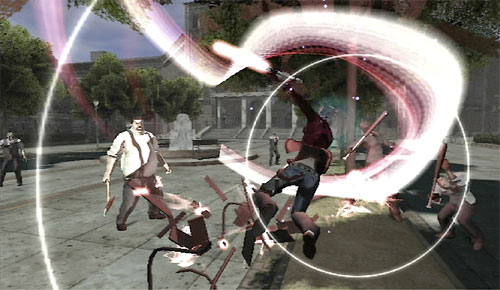
"An over-the-top brawler powered by absurdity."
No More Heroes 2: Desperate Struggle is the newest game from the twisted mind of Suda 51. This time around, the zany brawler comes in a more streamlined package than the first, trimming the fat to bring you more ridiculous action.
Desperate Struggle stars Travis Touchdown, the anime/videogame loving assassin, as he battles his way up the ranks of the UAA once again. This time, Travis is trying to take down the number one assassin to avenge the death of his friend, Bishop. But even if you haven’t played the first game, jumping into the second shouldn’t have you too confused. In fact, the characters even playfully break the fourth wall in the beginning to mention that some players are skipping the first game and don’t care about the past events.
No More Heroes 2 is, for the most part, a brawler. The controls feel very similar to the first game, though combat is a little more fluid this time around. You no longer have to be locked on to perform an emergency evade (dodge roll) and the camera now does a much better job of following you. Travis can perform attacks both with his beam katana and with his fists and feet. These attacks are performed using buttons with the angle of the Wii Remote determining a high or low attack. Switching between high and low as well as between slashes and punches can lead to extended combos.
When an enemy’s life is almost depleted, it’s time for a deathblow. Though this is technically a Quick Time Event (a mechanic most gamers dread by now) involving a swing of the Wii Remote in a given direction, it actually feels great and accents the button-based combat brilliantly. This is largely due to how forgiving they are. The purpose of the QTE’s becomes a chance to pull you into the action rather than to give you an opportunity to fail. The combat is a great mix of buttons and motion control that rely on neither too heavily.
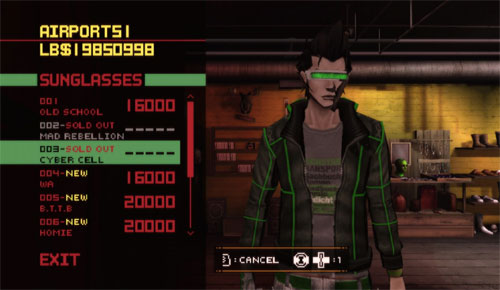
"You can buy clothes... like Space Glasses."
If an enemy is stunned, you can perform a wrestling move on them. This is also done with well executed, motion-based QTEs. Unlike the first game, Travis will automatically stab an enemy after the wrestling move, eliminating the need to do so manually. This basically turns wrestling moves into an alternate form of deathblows, speeding up the combat in the process.
If you can deal enough damage without taking damage yourself, you can enter Darkside Mode. There are several different things that can happen, depending on the results of a quick slot machine. While some are fairly ordinary like slowing all enemies down, another involves you transforming into a tiger.
There are several different beam katanas you’ll acquire throughout the game. While these don’t have any visible stats, they effect your fighting style greatly. Some are better for taking on faster enemies, others for larger groups, and so on. It’ll also be convenient to obtain extra beam katanas since they each have their own battery gauge. While you can recharge any katana by shaking it, it’s often best to switch weapons instead when you’re in the heat of battle.
The game’s strongest aspect is the boss battles. Each fight feels unique and, with a few exceptions, the bosses are very memorable. While one battle has you dodging wall lasers and missiles fired from a cult leader/hip hop artists’ ghetto blaster, the next has you fighting a football player in a giant robot made out of his own cheerleaders. Almost every boss is a treat. Strangely, though, a few of them don’t have stages leading up to them which is a bit disappointing. Luckily, those are the minority.
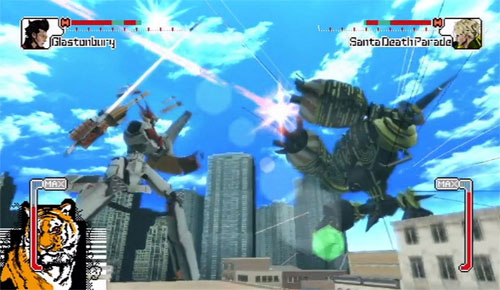
"Each boss battle has its own unique flavor."
While the ranked battles that progress the story are now free to enter, you can still do odd jobs to earn cash for clothes, beam katanas, and stat upgrades. These jobs (with the exception of one) are done in 8bit mini games. For the most part, they are pretty fun. One has you playing a version of Pipe Dream where you must run around and pick up the various pipe fittings and carry them, Captain N style. Another has you playing a Mach Rider clone to deliver pizzas.
You’ll also play retro games to increase your stats. There are two gym mini games; one for health and one for attack. With each success, they get both harder and more expensive. The problem with this is that you must pay for each attempt. If you fail to do well enough, you won’t get the stat increase and your money will still be spent. You can easily blow through your cash with failed exercises if you’re not careful.
The open world of the first game has been completely removed in favor of a stylized menu. Rather than padding the game by forcing you to drive through a mostly empty city, you’ll spend the extra time fighting 50% more bosses (that is definitely a good thing). There are still collectibles to accumulate in your motel room, but they’re all found within the ranked battle stages. While at your motel, you can play with your cat, change outfits, and even play a SHMUP on your TV among other things.
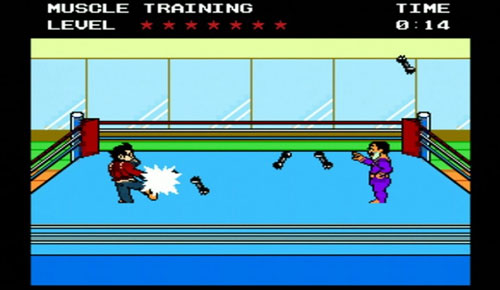
"Training and side jobs are both accomplished through 8bit mini games."
To mix things up a bit, you’ll play as two other characters for a small portion of the game. These characters, Henry and Shinobu, each have their own abilities. While the boss fight as Henry is a nice diversion, the Shinobu missions felt lackluster. This is mostly because Shinobu, unlike other characters, can jump. Unfortunately, she can’t jump well and there are some incredibly frustrating platform sections that feel really sloppy. The game was obviously not designed with jumping in mind. There are also a few optional Revenge Missions. But other than an aesthetic prize from completing them all, there’s not much point to them as they seem to award you very little money.
The visual style looks better than ever. Both the menus and the in game graphics look great, and the music works well, too. On the flip-side, there are a few aesthetic aspects of it that lack polish. You’ll find plenty of invisible walls throughout the game and enemies will often repeatedly spout the same line over and over again. It’s hard to tell if this is another result of Suda’s strange sense of humor or an honest oversight. Either way, it gets a bit annoying.
It should be noted that, while I would consider much of the game to be “immature”, the game has a “Mature” rating for a reason. Despite being stylized, Desperate Struggle is quite violent, has plenty of swears in the dialogue, and has its fair share of sexual themes. It’s far from subtle, so if you’re offended by this you should steer clear.
No More Heroes 2 is very fun. While the combat isn’t especially deep, it’s very satisfying. And thanks to the streamlined setup, you’ll be fighting more than anything else. Playing the first game after finishing the sequel feels like a convoluted mess by comparison. While not perfect, Desperate Struggle is a delightfully absurd action game worth checking out.

Tags: action, brawler, Grasshopper Manufacture, Marvelous Entertainment, No More Heroes 2: Desperate Struggle, space glasses, Suda 51, Ubisoft, Wii
This entry was posted on Monday, February 15th, 2010 at 5:00 am and is filed under Reviews. You can follow any responses to this entry through the RSS 2.0 feed. You can leave a response, or trackback from your own site.




February 15th, 2010 at 11:12 pm
Dynamo8 says:This is one of the most innovatve games I’ve ever seen in a long time. I should get this. . and thanks for the review!