
Review: The King of Fighters XIII (Xbox 360, PS3)
Just over two years ago, The King of Fighters XII released with a great fighting system, a hopelessly broken online experience, and an almost complete lack of single player modes. Today, the latest entry in the series releases with the intent to right the missteps of its predecessor.
The expanded roster of The King of Fighters XIII doesn’t have much new for the series, but it brings back a lot of the fighters missing from XII including Team Women Fighters members Mai, King, and my personal favorite, Yuri. With over 30 fighters available, the amount of choices are once again approaching the levels of its decade-old asset ripping, last generation entries.
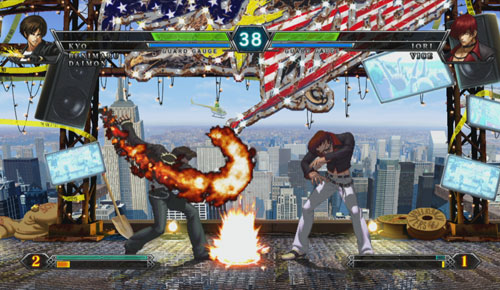
Cancels are the name of the game here as XIII features Guard Cancels, Drive Cancels, Super Cancels, Hyperdrive Cancels, and Max Cancels. What does it all mean? As long as you have the required power in your gauges to pull it off, you can cancel most actions midway through to create utterly devastating combos. Of course, there are limitations. You can’t cancel an attack with the same attack, for example. But you can cancel it with the EX version.
EX Specials are practically identical to those found in Street Fighter IV, though they take the same amount of power as a Desperation Move (read: Super Special), meaning you’ll likely use them less often and more deliberately. There’s an interesting risk/reward aspect to the supremely powerful NEO MAX attack. You can actually lessen how much of the power gauge it requires by going into Hyperdrive Mode. The catch is that your Drive Gauge will start to decrease, giving you a limited amount of time to perform the attack as well as giving away your plans to your opponent.
The Evasive Roll and Blowback Attack make a return to round out your defensive options. Rolling through enemy projectiles and countering melee attacks with pin point timing never stops being satisfying.
If this all sounds daunting, you’ll be happy to know there are a couple teaching tools to help you out. Tutorial mode will have you perform all of the base mechanics step by step while the Trials mode teaches you character specific combos. As you progress, the combos become absurdly long. Fortunately, you can watch a demo video of each one to give the wall of arrows on the screen a very real sense of context.
Arcade mode is far more substantial than the last entry with tons of (skippable) dialogue specific to every single matchup of characters, a few semi-animated cutscenes, and two end bosses. But it just wouldn’t be a fighting game if the bosses weren’t incredibly annoying. The first has both a move that immobilizes you and another that involves lifting you up and slowly punching you several times for what feels like an eternity (but is actually about three seconds). The second isn’t much better as he shoots projectiles at aggravating quantities. Will anybody ever make a fighting game boss that isn’t a chore to play? I have my doubts.
Other fighting game staples such as Time Attack, Survival, and Story Mode make an appearance. Despite their common nature in the genre, their additions are worth a mention since the last game managed to leave all of these things out. While I’m glad Story Mode gives the player more to do when playing alone, its execution is a bit questionable. Most of the story taking place is only tangentially related to any of the fighting you’re doing. In fact, most of the cutscenes involve non-playable characters. That coupled with some slow pacing in the introduction make the whole thing come off as awkward. Still, I’ll admit that there’s some nice artwork in it and the ability to start at any chapter alleviates the frustration of losing.
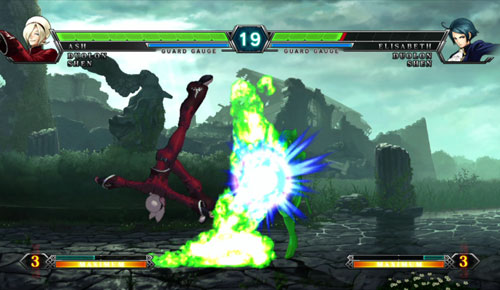
Speaking of nice artwork, I can’t speak highly enough of the sprite work. The animation of every character is silky smooth and there’s a high level of detail both in the characters and the stages. It really shows how modern 2D artwork can rival or even surpass the 3D models that so many other fighters have chosen to use.
Online has been streamlined with a much more logical menu structure. You can also play Arcade or Practice Mode while waiting for challengers. And the ability to setup a profile team makes “maining” a team of three specific characters much quicker to choose. As far as lag, my experience was all across the board. While I did have one match that was completely free of lag, others (including some in controlled environments with fellow reviewers) were victim to slowdown and occasionally choppy. I can only hope that this is tightened up over time.
The King of Fighters XIII is a far more substantial package than its predecessor in terms of modes and characters and the mechanics have an extra layer of refinement. In spite of its issues, it’s still an easy recommendation to fighting game enthusiasts who aren’t already burnt out on the series (especially at its semi-budget price). Even newcomers can work their way up thanks to multiple in-game learning tools.
This review is based on the Xbox 360 version of The King of Fighters XIII provided to the reviewer by Atlus.

Tags: 2D Fighter, Atlus, fighting games, King of Fighters, King of Fighters XIII, KOFXIII, ps3, SNK Playmore, Xbox 360
This entry was posted on Tuesday, November 22nd, 2011 at 12:00 am and is filed under Reviews. You can follow any responses to this entry through the RSS 2.0 feed. You can leave a response, or trackback from your own site.





November 29th, 2011 at 5:01 am
Barrel Roll #143 - “Spyro the Hedgehog” - WingDamage.com says:[...] reviewed The King of Fighters XIII and gives us the full rundown on this edition’s updates (this time there are modes!). Jonah [...]
August 20th, 2012 at 5:01 am
Persona 4 Arena Review: Simply Complex - WingDamage.com says:[...] I typically align with. As an initial game, it may not boast the roster numbers of games like The King of Fighters XIII or Street Fighter X Tekken, but (with the exception of one half-clone) these 13 fighters are as [...]