

Decisions, Decisions: To Roleplay or to Exploit the System?

Video game narratives have so much potential. Through this interactive medium, we are often able to forge our own version of a story with the power of player choice. But despite so many games providing us with options, we are often left creating not the story we want, but the one that fits in line with predetermined binary extremes.
The moment a game rewards you with good or evil points, you start to decide which of the two moralities you want to base all future decisions on. This is because we have been trained to assume that there are far greater benefits from leaning to one side than finding a happy middle ground. Sadly, this assumption is usually correct.
This severely limits the variance between each player’s experience. We stop trying to roleplay a character and instead find ourselves exploiting each decision to reach a specific desired end (whether it be special powers or a literal ending).
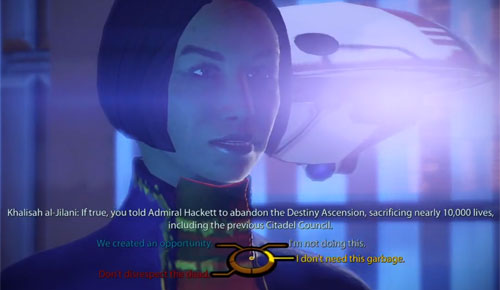
"Do you want Paragon or Renegade points in Mass Effect 2?"
It also bases everything on a predetermined moral compass. This is problematic as roleplaying enthusiasts know there is a huge difference between a character who is “Lawful Good” and one who is “Chaotic Good”. Yet, occasionally games will tell you that you’re evil for choosing one or the other.
Mass Effect 2 has often been praised for its array of dialogue options, but while it is a very good game, it still falls prey to a lot of these same problems. Often times dialogue is colored bright blue or bright red, essentially telling the player, “Click here for Paragon points or click there for Renegade points.” The game practically begs you to exploit it instead of encouraging you to choose what your version of Commander Shepard would actually do in that situation. Fortunately, there are a handful of more meaningful decisions as well, but they’re often in the minority.
Catherine was certainly on the right track, but it wasn’t perfect either. The text message approach to dialogue trees is genius. By allowing you to build a conversation from several blocks of text (each of which have their own array of multiple choice options) before sending it off, the triggers for the results you witness are far more obscured. Still, with a morality meter shown immediately after clicking the send button, I still found myself choosing what I thought the game wanted me to say to make the bar slant to one side or the other. Despite making it harder to game the system, they still directly encourage you to do so by showing your immediate results.
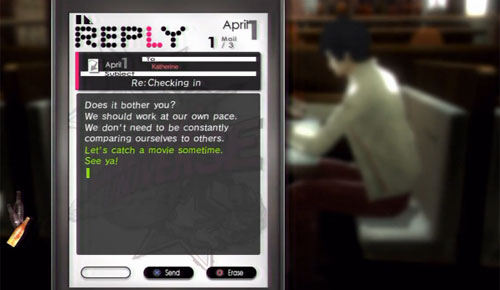
"This is four different dialogue decisions in Catherine queued up before hitting send."
The biggest mistake most developers make with player choice is limiting it to morality in the first place. Other characters within a game’s world shouldn’t respond to you based on some magical newsletter they received letting them know whether you’ve spent your time being a jerk or a nice guy. Instead, they should act based on whether or not they agree with how you handle the situations they are aware of.
Deus Ex: Human Revolution is a game full of choices, but you won’t ever see points fed into a red or blue bar. Because of this, I finally felt free to do what I wanted. If I decided to be a jerk to somebody, it wasn’t because I wanted to save enough jerk points to get me into the jerk club down the road. It was because I didn’t like the guy and I wanted him to know it.
You could argue that most of the major dialogue trees in Human Revolution are still a means to an end, and you’d be right. But they aren’t about being good or evil. They are about getting inside the head of the person you’re talking to and manipulating them into doing what you want. Most importantly, these dialogue trees are incredibly satisfying experiences that manage to make talking to somebody a game in itself. Who knew that talking could be so much fun?

"Which version of Cybil will you meet in Silent Hill: Shattered Memories?"
The art of subtlety is difficult to achieve, but Silent Hill: Shattered Memories managed to do so exceptionally well. You are constantly judged by your actions and you’re in a constant state of making decisions whether you realize it or not. Did you answer that phone call? Which room in this building did you enter first? How was your eye contact during that last conversation? Did you examine the clothing on that mannequin a little too closely? You will be judged on all of these things without ever being told.
Even the game’s therapy sequences play with your head by presenting you with tasks such as ranking people in a story in order of bloodguilt, or picking out which people in photos are sleeping and which are dead. The result of therapy and the subtle ways you interact with the game world determine not only your ending, but the way certain locations and characters look and act, your own dialogue during cutscenes (which you do not get to choose directly), and even your own personality profile after completing the game.
To successfully make a decision based game interesting, it is crucial to avoid black and white situations. Judge a player when they think the developer’s all seeing eye isn’t looking. Obscure which piece of chosen dialogue triggers different reactions. And most importantly, make players feel a sense of freedom instead of compulsion.

Tags: Catherine, Deus Ex: Human Revolution, Mass Effect 2, Silent Hill: Shattered Memories, story
This entry was posted on Monday, October 3rd, 2011 at 5:00 am and is filed under Articles. You can follow any responses to this entry through the RSS 2.0 feed. You can leave a response, or trackback from your own site.









October 3rd, 2011 at 7:32 am
Jonah Gregory says:Yes another reason I think you would enjoy Fallout 3. There is a middle ground, and there are even some perks specific to it.
October 4th, 2011 at 5:21 am
Michelle says:I know exactly what you mean, but I’ve noticed something even more problematic.
In these sorts of decision making games, I tend to go with whatever path is hardest to achieve. For example in most games playing the game as a “good” character is much harder to achieve than a “bad” one.
That’s another good reason why developers should try to muddy the waters when it comes to morality.