

Review: Catherine (PS3, Xbox 360)
"A psychological thriller about relationships... and block pushing."
In an industry saturated with shooters and sandbox games, the best word to describe my feelings on Catherine is “refreshing.” Part puzzle game, part choice-based story game, Catherine is almost two separate entities. Yet somehow this odd mixture ends up working wonderfully together as each side enhances the other.
One of the great things about Catherine is that its story isn’t one you would typically find in this medium. I was reminded more of movies like Satoshi Kon’s Perfect Blue than anything I’d experienced in a video game. Like all good psychological thrillers, Catherine is hard to put down. Combine that with the addictive nature of the puzzle stages and I can tell you I had some pretty long sessions each time I sat down to play.
To say too much about the story would ruin the experience, but here’s a taste. Vincent has been dating his girlfriend Katherine for five years. While he’s comfortable with their current life, Katherine is clearly hinting at tying the knot. Vincent gets stressed out and wakes up in bed with the similarly named Catherine thus complicating his love life. All the while there are mysterious deaths reported in the news along with strange rumors of cheaters having fatal dreams.
The daytime sections are broken up between a few cutscenes and a controllable section in the local bar. While in the bar, you can talk to your friends and the various customers, all of which have their own intriguingly screwed up past to gradually reveal to you. As you talk, time will actually pass and customers will come and go making it not always possible to talk to everyone before they leave. This is key as their very lives can depend on how much attention you give them.
You’ll also get text messages and the occasional phone call from (C/K)atherine. The text message interface is genius, allowing you to stitch together a message by combining several multiple choice responses together. This non-binary approach makes it less clear how each piece affects the morality gauge, though you’ll still see the gauge results from the finished message.
From the outset the game makes it clear that you are not role-playing as Vincent. Instead, the entire game is presented as a late-night movie that you’re watching. No matter who the player is, Vincent is always a very pre-defined character within the story that you merely guide along. While each of the game’s eight endings are wildly different, the narrative leading up to them unfortunately doesn’t change that much from your actions. While it’s a really interesting mystery story that I enjoyed experiencing multiple times, the small amount it changes aside from the ending feels like a missed opportunity.
Of course, if you don’t enjoy puzzle gameplay you’re out of luck. The puzzle stages make up a large portion of the game. Thankfully, they’re really rewarding to play and give extra weight to the story instead of feeling out of place. There’s even a bit of narrative choice mixed in between each of these stages in the form of confessional booths with questions that actually changed on my second playthrough.
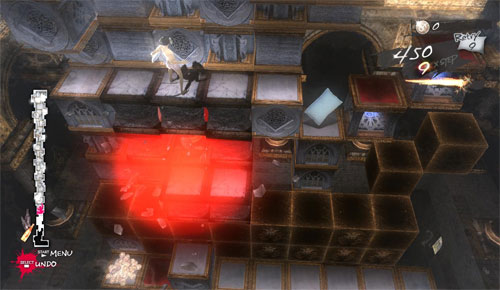
The blocks you must manipulate as you climb each tower obey a strange set of rules. Blocks can be suspended in mid-air if they’re touching the upper edge of a block below, resulting in some really interesting situations. The nightmare world will always keep you on your toes by adding new enemies and block types with unique properties. Even at the end of the game, they don’t hold back in introducing new elements keeping the puzzles fresh.
The amount of puzzle stages you play before returning to the real world gradually increases as you progress, but they’re always punctuated by a boss stage. You don’t fight bosses so much as run away from them. Some of the puzzles in these stages actually feel a little easier since the focus is more on speed, but the tension definitely rises.
Most of your success will require quick thinking as even normal stages have the floor gradually destroyed out from under you. But Catherine makes great success by having many ways to approach the tower. Most of the time when I solved a particularly complex puzzle I would already forget my solution by the time I reached the end. This made my second playthrough still full of satisfying challenge.
Atlus didn’t skimp on Catherine‘s production values. The game is peppered with fully animated scenes by Studio 4°C, in-game graphics that look almost as good, and top notch audio. The voice acting is fantastic with the possible exception of Katherine who feels a bit awkward at times. The music is also great, especially in the puzzle stages which use remixes of classical music.
In addition to the story, there’s also partially randomized extra stages, competitive and cooperative multiplayer, and an arcade game in the bar that puts a neat twist on the puzzle gameplay. Eight endings aside, the main game will require at least two playthroughs to really get to know everybody in the bar and watch Vincent’s internal thinking change.
Catherine is not at all intended for younger players, but those who enjoy a mature themed psychological thriller and rigorously challenging puzzle gameplay will find a lot to love.
This review is based on the Playstation 3 version of Catherine purchased by the reviewer.

Tags: Atlus, Catherine, ps3, puzzle games, story, Xbox 360
This entry was posted on Wednesday, August 17th, 2011 at 5:00 am and is filed under Reviews. You can follow any responses to this entry through the RSS 2.0 feed. You can leave a response, or trackback from your own site.








August 17th, 2011 at 10:26 am
Jonah Gregory says:This game seems combine two things I enjoy; puzzle games and bizarre mysteries. I look forward to playing it.
October 3rd, 2011 at 5:01 am
Decisions, Decisions: To Roleplay or to Exploit the System? - WingDamage.com says:[...] Catherine was certainly on the right track, but it wasn’t perfect either. The text message approach to dialogue trees is genius. By allowing you to build a conversation from several blocks of text (each of which have their own array of multiple choice options) before sending it off, the triggers for the results you witness are far more obscured. Still, with a morality meter shown immediately after clicking the send button, I still found myself choosing what I thought the game wanted me to say to make the bar slant to one side or the other. Despite making it harder to game the system, they still directly encourage you to do so by showing your immediate results. "This is four different dialogue decisions in Catherine queued up before hitting send." [...]