Review: Assassin’s Creed Brotherhood (Singleplayer) (Xbox 360, PS3)
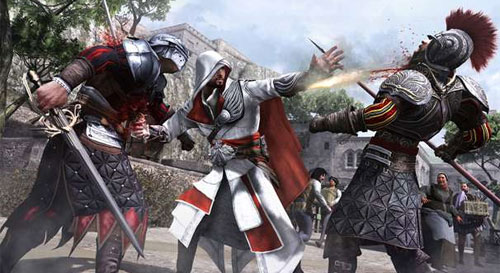
"When in Rome, do as the assassins do."
What’s this? Crotchety old schooler Adam is reviewing a modern, immersive, narrative-driven game!? After all that stuff he’s said about old games being so much better!? What’s the world coming to!?
Yes, ladies and gentlemen, I know this is quite a shock to you all. I am outed. Much in the same way a Halo and God of War loving self-proclamated hardcore would be sheepish to admit he likes Pokémon, I must confess that Assassin’s Creed is one of my guilty pleasures.
Okay, so it’s not like I’m actually embarrassed about it or anything. And as much as I’d love to review something like Donkey Kong Country Returns, truth be told I was looking forward to Assassin’s Creed Brotherhood for some time (or AssCreBro as we’ve come to call it around the WingDamage HQ).
So how does it stack up?
Some people have dubbed this game Assassin’s Creed 2.5 and honestly, such a label is neither untrue nor unkind (well, depending on how you feel about Assassin’s Creed 2). Despite the new locale and other new assets, you will pretty much feel like you’re playing Assassin’s Creed 2. Storyline-wise, the game even picks up at the exact moment Assassin’s Creed 2 left off. Soon Monteriggioni falls under siege, and Ezio travels to Rome, which is under the oppression of the Borgia family. Ezio will have to fight to free Rome from the tyranny of his new nemesis, Cesare Borgia, as well as retrieve the Apple that was stolen from him. In the present, Desmond replays these memories with the prospect of further improving his assassin’s skills and locating the Apple in the present day.
Rome is by far the biggest parkour playground featured in any Assassin’s Creed game, and is boasted as such. However, it’s also the only one. Some side missions will take you to other regions, but they’re much smaller and more linear in design. For that reason, Rome features a gamut of terrain types, including large, bustling city blocks, smaller scatters villages, and rural expanses. In a sense it feels like they took all the locations from Assassin’s Creed 2 and rolled them up into a single, huge stage.
One of the game’s primary features is freeing Rome from oppression and restoring it, which in turn supports your own crusade. This is carried out by taking down Borgia towers, of which there are ten. Each one carries influence over a certain area of Rome. You must infiltrate them, assassinate the commander in charge, and then burn down the tower.
Once you free the area, you can start opening shops and buying landmarks there, which in turn provides you with continual income. Each tower has a difficulty rating based on its layout, and also two types of commanders: those who stay and fight, and those who try to flee if they catch wind of you. Truth be told, though, they’re not terribly tough if you recon enough, and I managed to take down a four star tower pretty early in the game. The only real “loss” is if the captain manages to escape, in which case you need to wait an in-game day for him to return.
Other ways of effecting change, and padding your pockets, include paying to have aqueducts repaired, opening up underground tunnels for fast travel, and establishing factions for the mercenaries, courtesans and thieves. What’s more, while the initial game objectives will have you do these things just to get a taste for them, for the most part you’re free to tackle them at your own pace. You can use your money to open up new shops as soon as you get it, or buy up weapons and artwork instead. You can try to take down as many of the Borgia towers as possible right away, or not take down any. You can do as much or as little as you want as you see fit.
Besides all this, there are a number of other side quests to distract you from fulfilling the main objectives, including assassination contracts, helping courtesans, hunting down Templars and reliving Ezio’s heartbreaks. Oh, and collecting flags.
Then of course there’s the brotherhood; the titular feature to the game. As the story progresses, Ezio decides to form and train a brotherhood of assassins. You will find citizen recruits being hassled by the guards (an event reminiscent of citizen rescues from the original Assassin’s Creed), and rescuing them will bring them to your ranks. You can find three to start with, and add an additional recruit with every Borgia tower you bring down.
Once you have them, it’s your job to train them. This is accomplished by sending them on missions all across the continent to level them up. A rate of success is determined by the difficulty of the mission, the number of assassins you send and how skilled they are. Leveling them up allows you to improve their weapons and armor. Truth be told, despite “Brotherhood” finding its way into the game’s title, you can’t really ineract with them and they have extremely little bearing on the story. They are little more than your personal hit squad.
And man, what a job they do. Target any unfortunate guard, hit the left bumper, and your crew will fly in and go to town. Early on, I accidentally called a newbie assassin trying to target a guard. I figured he was done for and rushed in to save him, but he felled the guard before I could get there. In fact, once you have six assassins at the ready, you can hold the left bumper to summon an “arrow storm.” And that’s really what it is: arrows will fly in from seemingly nowhere and kill every guard in your vicinity. There was one mission where I was required to assassinate my target while sitting down to get full synchronization from the mission. However, a gaurd was standing right in front of me. I figured I’d target him and summon an arrow to take him out quietly, rather than have an assassin jump in and cause a commotion. Instead, every enemy was slayed, including my target, who I didn’t even see at the time. The mission ended.
Of course, that doesn’t mean Ezio doesn’t have to get his hands dirty. While the game does open with a typical “you lose all your stuff” bit, you still do get to hang onto your hidden blade, which has the poison tip and the pistol. From there you can get new weapons and armaments from shops. You can also meet Leonardo for special missions to get new equipment from him. There are a few new weapons, including the devastating crossbow. It’s every bit as deadly and accurate as the pistol, but you can carry much more ammunition with it.
Combat has also changed a little. In order to move fighting away from the counter-attack waiting game, and to allow for much more threatening enemies, the combat now has a “first strike” system. Simply put, whenever you kill someone, you can immediately target someone else and immediately execute them before letting them get a move in. If your timing is good, you can chain this action and take down huge groups of enemies in no time. This is useful especially for getting the jump on larger, heavily armored guards who you can’t counter-attack.
Truthfully though, not much else has changed. The core gameplay, the enemy AI, and even a bit of the music and soundbites are all the same from Assassin’s Creed 2. It also still has the same, somewhat unrefined control system, where your player character doesn’t always jump the way you command him (and usually plummets to his death as a result). To consider the singleplayer alone, it is a smaller game as well, even with the huge amount of optional side missions. I know to overlook multiplayer is missing out on one of the major elements of the title, and the way they formulated it sounds pretty unique, but it’s not something that grabs me so far.
So as a continuation of the storyline, it reaches the same great standard the series is now known for, but there’s just less of it. On the other hand, they truly went all out with the story. While it is a shorter adventure, it doesn’t mean what happens doesn’t matter. I am pretty sure playing the next major Assassin’s Creed installment without following the events of this title would lead to some confusion. That is definitely something to keep in mind when you weigh the value of this title. Overall, if you enjoyed Assassin’s Creed 2 and want to keep up with the story, Brotherhood will probably come through for you. Otherwise, unless you’re really dying for some new online multiplayer gameplay, I wouldn’t recommend jumping into the series here.
This review is based on a copy of Assassin’s Creed Brotherhood purchased by the reviewer.

Tags: action, adventure, Assassin's Creed Brotherhood, AssCreBro, review, singleplayer, Ubisoft, Xbox 360
This entry was posted on Friday, December 10th, 2010 at 5:00 am and is filed under Reviews. You can follow any responses to this entry through the RSS 2.0 feed. You can leave a response, or trackback from your own site.