
Digital Borders: A Local Community on a Global Scale
The Internet is credited and accused of many things, almost all of which are true. The flow of information has become almost instantaneous among the more developed nations allowing soldiers in Iraq to talk to loved ones at home, businessmen to converse between Turkey and Hawaii, and news to be spread and accessed by millions of people before it can even be verified. For the generation that came after the Baby Boomers and who grew up with computers being fairly commonplace by the time most of them were old enough to care, the Internet has arguably done more to shape the world as they understand it than any other singular entity.
Two important introductory concepts in Human Geography are “interdependency” and “globalization”. There are some who believe that with the rapid pace of globalization linking people in manners beyond physical connections, political boundaries will become less important to the point of making the very concept of a “nation-state” obsolete. Nothing will be analyzed on the scale of community or national level; everything will be global.
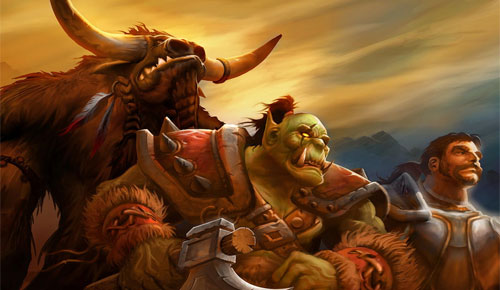
Perhaps one of the strongest examples of this phenomena is the online gaming community. Community, by definition, is simply a collection of individuals with common interests or attributes, which can refer to something as small as a neighborhood or as far reaching as a region (or a collection of nation-states, such as Western Europe or South-East Asia). Here, it can be illustrated how individuals are capable of relating and self-identifying more strongly with other individuals whom they have never interacted with outside of a digital environment than with their physical neighbors; furthermore, they may place the interests and attributes that define their virtual community higher than a political allegiance. An example of such a community revolves around the Massive Multiplayer Online Role Playing Game (MMORPG), World of Warcraft (frequently shortened to WoW). Like any other MMO, players pay a monthly fee for the right to log and interact not only with the game itself, but with other players from all over the world. At this point, WoW boasts 11.5 Million monthly subscribers from over 30 countries, speaking dozens of languages. This has numerous sociological and geographical implications.
For instance, although someone in the United States would not be able to access a server intended for someone in Japan (and thus could not converse with him/her), both could hear a reference (in their respective languages) to the same game item (an enemy, an item, a quest, etc) and have an identical concept of it. Likewise, countless people from Europe discuss in-game news with those from the United States, knowing they will never meet them off-line. The ramifications of this is that it is less important to the individuals where someone is from as opposed to how well they play the game. The politics of the real world rarely penetrate this digital fortress because of the tacit agreement between the players that it is simply unimportant. Some argue that this is due to the demographic of players (implying that these are children to young adults with no stake in politics), but because people of all ages and levels of activism play, this is an extremely flimsy argument.
Similarly, though this virtual world is separate from the “Real World”, it is not wholly isolated, and what happens in the Real World affects the game, much the same way that global politics affect community life and the actions of individuals can change the global community. For example, though there are many kinds of creatures and animals a player may fight, one he/she will never come across is referred to as a “Panderian” within the Lore (the backstory of the game). Subscribers who have played Warcraft I-III (which WoW is based on) are familiar with the animal, but because it strongly resembles a Panda (giving it its name), it cannot be coded into the MMO. This is due to the fact that in China, it is illegal to have any game demonstrating, encouraging, and/or requiring the death or harm of a Panda. The company that owns World of Warcraft would lose a large percentage of subscribers because of a national-scale consideration they have to take into account. On a slightly more positive note, many references are coded into the game that go back to Real World topics and cultural icons.
The World of Warcraft can affect the World of Reality as well, giving them a dynamic relationship. Certain countries in Asia have a significant portion of their economy based on WoW and games like it, the loss of which would provide some serious financial problems. Yet most players do not think about forces like this. What they are interested in is the true core of this online community, that is, the attributes they share with each other and the interactions they face on a day-to-day basis. There is almost definitely more people (especially more Americans) who could point to and name every region in Azeroth (the world that WoW takes place in) than could find Wisconsin, Sweden, or Yugoslavia. Such people can recite the history of the Dwarves, the Night Elves, the Forsaken and the Trolls, but could not name the 12th President of the United States or answer when the Cold War ended. They are well-versed in all the latest abilities and make certain they are aware of even the slightest shift in gameplay, story, or tactics, but have no interest in the workings of the United Nations, the European Union, or NATO. Becoming indignant when someone says that a Paladin is far superior to a Warrior, these individuals probably couldn’t care less about the workings of the Taliban. It is not that they are irresponsible, apathetic, or are merely trying to escape. Instead, it is a matter of priorities and identification. They see themselves more as Krognar, Blood Elf Rogue of Silvermoon City than as a student, a worker or a citizen of the United States.
Though at initial glance, there appears few positive consequences of this, it is important to remember that this is merely the manifestation of a changing global community and a reflection of a world based less on borders, race and economic status, and more on a spirit of cooperation, competition, and self-identification within the confines of a digital world defined by shared interests and common attributes.

Tags: MMO, MMORPG, online communities, online gaming, World of Warcraft, WoW
This entry was posted on Monday, May 4th, 2009 at 5:00 am and is filed under Articles. You can follow any responses to this entry through the RSS 2.0 feed. You can leave a response, or trackback from your own site.




May 4th, 2009 at 8:41 pm
MrColinP says:I have two questions about your very thoughtful article:
1) I’m interested in defining the term “community” a little further. Let’s say that there’s a large group of people who existed during the 1950′s who all like the same film, but don’t interact in any way. Would knowing about the same movie references make them a community?
2) What specific attributes does the internet posses that make it facilitate a “world based less on borders, race and economic status, and more on a spirit of cooperation, competition, and self-identification within the confines of a digital world defined by shared interests and common attributes”?
May 5th, 2009 at 3:52 pm
shaolinjesus says:World of Warcraft Leads to Middle East Peace Agreement
AP - Spontaneous peace broke out between Palestinians and Israelis when members of both groups realized that they were all members of the same WoW guild. Israeli Prime Minister Benjamin Netanyahu spoke to a group of supporters extolling the virtues of Hamas Paladins “We were surrounded by some punk #$% Horde in the middle of some insane PvP when 3 Hamas Level 68 Paladins came rolling through. They were total tanks. I am totally down with a 2 State solution if it means those guys can help me get some fat l00tz.”
Sigh… I wish