

Review: Space Invaders Infinity Gene (XBLA, PSN)
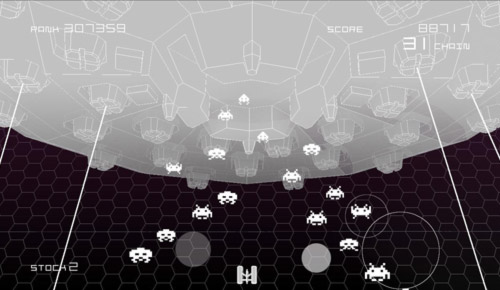
If you listen to the Barrel Roll! podcast, then you know I’m the type to knock down a cinematic, goppy, story-driven, fully orchestrated game in favor of a simple, arcade-style, jump-on-in style game. So it might surprise you to learn that, well… I’ve never much cared for Space Invaders! And this is true for the vast majority of shoot-em-ups.
I’ve just never had the interest and patience to develop skill in them, and outside of a handful of very simple shmups like B-Wings and Volley Fire, I’ve hardly given them the time of day. Of course, Space Invaders is the simplest of all shmups, but it’s so primordial. Being born in 1983, I am not a true child of the arcades - I got into gaming at the tail-end of the NES era. To really get into Space Invaders, I would need it to evolve.
Fortunately for me, Space Invaders Infinity Gene is centered around evolution. And it isn’t just because the stages are named after odd genetic and cellular terminology. The game actually evolves as you play it, both in a stylistic sense and in actual features — the more you play, the more it grows.
The game introduces this concept to you in a “Stage 0,” which is a mock-up of the very original Space Invaders. But this segment abruptly ends with a quote from Charles Darwin about the strongest species being that which can adapt to its environment. Then the real game begins.
The action starts off simple and funky enough.
The key element in Infinity Gene is essentially leveling up. Starting out, you will level up pretty much every time you complete a stage. Something new unlocks each time you level up, whether it’s imperative gameplay elements such as being able to move in all directions, different kinds of weapons and the number of lives you can start a game with, or extra content such as bonus stages, challenge stages, and musical tracks in the sound test.
Eventually, though, you will likely hit a wall and get a game over (I did so on stage 2-3). However, if you get stuck on a stage, you can always go back and level up some more. You don’t get as much experience from stages you’ve already cleared, and I can’t tell what mechanic experience is based on (though it seems largely dependent on getting high chains and beating bosses - more on this soon). By leveling up, you will eventually get something that will help you beat that stage, be it a new weapon or more lives.
The weapons are surprisingly diverse, and there’s bound to be one that fits your style of play. You can also power up these weapons by defeating the iconic UFOs, which drop colorful nucleus-like items. Collecting these makes your weapon more dynamic and powerful, and you keep these upgrades until you lose a life, although it gives you a chance to collect them all again.
You initially start off with the regular shot, which can be powered up to a rapid-fire shot. Other weapons you will unlock include a long laser beam that bends to move towards enemies, a wave-like weapon that expands as it flies forward, and a shot that creates black holes which cover a large area and suck up enemy projectiles.
An example of the game’s outstanding boss battles.
There are a wide variety of enemies in the game besides the standard Invaders, and even these tend to come in a variety of sizes and attack patterns. Many other enemies are based on simply polygonal shapes and have their own unique weapons. What’s more, enemies don’t just come from the top, but also at the sides and even bottom of the screen. This is occasionally a hindrance, as sometimes a huge group of enemies will fly out rapidly, giving you almost no time to get out of the way. There have even been occasions where I’ve been killed by something while hanging out at the bottom of the screen, and never got to see what it was.
Many stages also have bosses at the end, which even have Darius-esque introductions (another Taito shmup), giving some personality to bosses that would otherwise be nothing more than curious geometric figures. Some of the bosses require clever means to defeat, while others are just huge and fire lots of bullets, needing to be shot repeatedly.
Beating bosses racks up big points, but they’re also timed, which is something the game doesn’t make apparent. If you take too long to beat a boss, it will just leave. You still get to complete the stage, but miss out on points and experience. You also rack up points by creating long chains, that is, continually destroying enemies. Many hoards of enemies, as well as non-threatening objects, appear for the sole sake of being cannon fodder for you to gleefully destroy.
Aside from the standard game, there are three additional modes. Bonus lets you play the bonus stages you unlock as you level up your ship. Challenge, meanwhile, presents you with a series of 99 stages, which allegedly change every time you play them. But the most interesting mode is Music, where the game will generate stages based on music you have on the Xbox 360 HDD.
The challenge definitely heats up the further you get.
I can’t tell what process Infinity Gene uses for this, aside from the fact that there’s a boss at the end of the song. However, this seems to be a feature that probably worked better on the iPhone version (which released last year), since I had a hell of a time trying to figure out how to put my music on my 360. Furthermore, if your music is in playlists, Infinity Gene will always just use the first song in that playlist. Since music I rip from CD on the 360 naturally seems to be put into a playlist, I haven’t found a way yet to use any other music besides the album’s first track.
While Infinity Gene would just be a fun and addictive arcade experience from the gameplay alone, what makes it even more enjoyable is its style. The simplistic, arcade-style graphics using lines, geometric shapes, and simple sprites, combined with the game’s beat-driven, electronic soundtrack by Zuntata (Taito’s in-house band) makes for a perversely enjoyable experience.
Even at times I didn’t feel quite like playing, I ended up getting drawn in with the deluge of thumping beats and bleepy sound effects. There’s something wonderfully mesmerizing about the experience. I wanted to compare it to the Bit.Trip game series, but oddly enough, I found it more reminiscent of the game Pulseman, which shares its electronic-styled soundtrack and computer-themed visual presentation.
For a mere $10 (800 MS points), you can get Space Invaders Infinity Gene for the 360, as well as the PS3, and I definitely think it’s worth the money. Many classic games have gone to some pretty odd places as they try to adapt to the modern age, but Taito maked sure that Space Invaders evolved the right way, keeping its core, addictive gameplay and using the technology for new surprises and sexy presentation. You will enjoy this game.
This review is based on the Xbox 360 version of Space Invaders Infinity Gene purchased by the reviewer.

Tags: Arcade, microsoft, ps3, psn, Shmup, shoot-em-up, Space Invaders, Space Invaders Infinity Gene, Taito, xbla, Xbox 360, xbox live
This entry was posted on Wednesday, September 29th, 2010 at 5:00 am and is filed under Reviews. You can follow any responses to this entry through the RSS 2.0 feed. You can leave a response, or trackback from your own site.









September 29th, 2010 at 1:09 pm
Jesse "Main Finger" Gregory says:This sounds really cool. The Music mode especially interests me. Sounds like it could be a funner version of the Audiosurf concept.